2004 - 2012
Showing posts with label science. Show all posts
Showing posts with label science. Show all posts
Sunday, August 4, 2013

Friday, September 16, 2011
Cultural Icon
comes to life

Wednesday night i watched the 1977 movie Star Wars, on Thursday NASA announced that their Kepler mission found a planet with two suns. They should have named the planet Tatooine.
http://science.nasa.gov/science-news/science-at-nasa/2011/15sep_doublesuns/
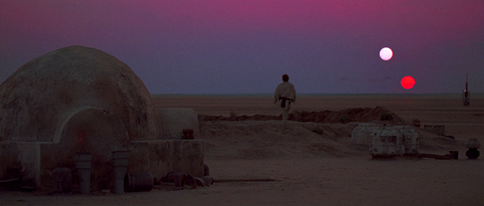
Wednesday night i watched the 1977 movie Star Wars, on Thursday NASA announced that their Kepler mission found a planet with two suns. They should have named the planet Tatooine.
http://science.nasa.gov/science-news/science-at-nasa/2011/15sep_doublesuns/
Thursday, August 18, 2011
Fact Theory and I Don't Know
Quotes and links to two very good articles i read today
Well evolution is a theory. It is also a fact. And facts and theories are different things, not rungs in a hierarchy of increasing certainty. Facts are the world's data. Theories are structures of ideas that explain and interpret facts. Facts don't go away when scientists debate rival theories to explain them. Einstein's theory of gravitation replaced Newton's in this century, but apples didn't suspend themselves in midair, pending the outcome. And humans evolved from ape-like ancestors whether they did so by Darwin's proposed mechanism or by some other yet to be discovered.
Moreover, "fact" doesn't mean "absolute certainty"; there ain't no such animal in an exciting and complex world. The final proofs of logic and mathematics flow deductively from stated premises and achieve certainty only because they are not about the empirical world. Evolutionists make no claim for perpetual truth, though creationists often do (and then attack us falsely for a style of argument that they themselves favor). In science "fact" can only mean "confirmed to such a degree that it would be perverse to withhold provisional consent." I suppose that apples might start to rise tomorrow, but the possibility does not merit equal time in physics classrooms.
-- Stephen Jay Gould
full article: http://sandwalk.blogspot.com/2011/08/evolution-is-fact-and-theory.html

What makes me libertarian is what makes me an atheist -- I don't know. If I don't know, I don't believe. I don't know exactly how we got here, and I don't think anyone else does, either. We have some of the pieces of the puzzle and we'll get more, but I'm not going to use faith to fill in the gaps. I'm not going to believe things that TV hosts state without proof. I'll wait for real evidence and then I'll believe.
And I don't think anyone really knows how to help everyone. I don't even know what's best for me. Take my uncertainty about what's best for me and multiply that by every combination of the over 300 million people in the United States and I have no idea what the government should do.
-- Penn, of Penn and Teller
http://edition.cnn.com/2011/OPINION/08/16/jillette.atheist.libertarian/index.html
Well evolution is a theory. It is also a fact. And facts and theories are different things, not rungs in a hierarchy of increasing certainty. Facts are the world's data. Theories are structures of ideas that explain and interpret facts. Facts don't go away when scientists debate rival theories to explain them. Einstein's theory of gravitation replaced Newton's in this century, but apples didn't suspend themselves in midair, pending the outcome. And humans evolved from ape-like ancestors whether they did so by Darwin's proposed mechanism or by some other yet to be discovered.
Moreover, "fact" doesn't mean "absolute certainty"; there ain't no such animal in an exciting and complex world. The final proofs of logic and mathematics flow deductively from stated premises and achieve certainty only because they are not about the empirical world. Evolutionists make no claim for perpetual truth, though creationists often do (and then attack us falsely for a style of argument that they themselves favor). In science "fact" can only mean "confirmed to such a degree that it would be perverse to withhold provisional consent." I suppose that apples might start to rise tomorrow, but the possibility does not merit equal time in physics classrooms.
-- Stephen Jay Gould
full article: http://sandwalk.blogspot.com/2011/08/evolution-is-fact-and-theory.html
What makes me libertarian is what makes me an atheist -- I don't know. If I don't know, I don't believe. I don't know exactly how we got here, and I don't think anyone else does, either. We have some of the pieces of the puzzle and we'll get more, but I'm not going to use faith to fill in the gaps. I'm not going to believe things that TV hosts state without proof. I'll wait for real evidence and then I'll believe.
And I don't think anyone really knows how to help everyone. I don't even know what's best for me. Take my uncertainty about what's best for me and multiply that by every combination of the over 300 million people in the United States and I have no idea what the government should do.
-- Penn, of Penn and Teller
http://edition.cnn.com/2011/OPINION/08/16/jillette.atheist.libertarian/index.html
Wednesday, July 20, 2011


Saturday, April 23, 2011
Skeptics
Michel de Montaigne (1533-92) is considered the Father of Modern Skepticism. Today, through the usual delightful interwebby way, i came across these quotes on wiki. Surprising, or not, how many i've heard paraphrased throughout my life.
"
I enter into discussion and argument with great freedom and ease, inasmuch as opinion finds me in a bad soil to penetrate and take deep root in. No propositions astonish me, no belief offends me, whatever contrast it offers to my own. There is no fancy so frivolous and so extravagant that it does not seem to me quite suitable to the production of the human mind.
Obsession is the wellspring of genius and madness.
Everyone calls barbarity what he is not accustomed to.
If you belittle yourself, you are believed; if you praise yourself, you are disbelieved.
When I play with my cat, how do I know that she is not passing time with me rather than I with her?
Life in itself is neither good nor evil, it is the place of good and evil, according to what you make it.
The continuous work of our life is to build death.
To forbid us anything is to make us have a mind for it.
Our religion is made to eradicate vices, instead it encourages them, covers them, and nurtures them.
Man cannot make a worm, yet he will make gods by the dozen.
Human understanding is marvellously enlightened by daily conversation with men, for we are, otherwise, compressed and heaped up in ourselves, and have our sight limited to the length of our own noses.
Not being able to govern events, I govern myself.
No matter that we may mount on stilts, we still must walk on our own legs. And on the highest throne in the world, we still sit only on our own bottom.
No man is a hero to his own valet.
I believe it to be true that dreams are the true interpreters of our inclinations; but there is art required to sort and understand them.
Whether the events in our life are good or bad greatly depends on the way we perceive them.
The only thing certain is nothing is certain.
Montaigne's axiom: "Nothing is so firmly believed as that which least is known."

Also caught in the web: http://www.economist.com/node/18584074?fsrc=scn/tw/te/ar/thegoodgodguide
First paragraph:
RELIGION is ubiquitous but it is not universal. That is a conundrum for people trying to explain it. Religious types, noting the ubiquity (though not everyone is religious, all human societies have religions), argue that this proves religion is a real reflection of the underlying nature of things. Sceptics wonder why, if that is the case, it comes in such a variety of flavours, from the Holy Catholic and Apostolic Church to the cargo cults of Papua New Guinea—each of which seems to find the explanations offered by the others anathema.
"
I enter into discussion and argument with great freedom and ease, inasmuch as opinion finds me in a bad soil to penetrate and take deep root in. No propositions astonish me, no belief offends me, whatever contrast it offers to my own. There is no fancy so frivolous and so extravagant that it does not seem to me quite suitable to the production of the human mind.
Obsession is the wellspring of genius and madness.
Everyone calls barbarity what he is not accustomed to.
If you belittle yourself, you are believed; if you praise yourself, you are disbelieved.
When I play with my cat, how do I know that she is not passing time with me rather than I with her?
Life in itself is neither good nor evil, it is the place of good and evil, according to what you make it.
The continuous work of our life is to build death.
To forbid us anything is to make us have a mind for it.
Our religion is made to eradicate vices, instead it encourages them, covers them, and nurtures them.
Man cannot make a worm, yet he will make gods by the dozen.
Human understanding is marvellously enlightened by daily conversation with men, for we are, otherwise, compressed and heaped up in ourselves, and have our sight limited to the length of our own noses.
Not being able to govern events, I govern myself.
No matter that we may mount on stilts, we still must walk on our own legs. And on the highest throne in the world, we still sit only on our own bottom.
No man is a hero to his own valet.
I believe it to be true that dreams are the true interpreters of our inclinations; but there is art required to sort and understand them.
Whether the events in our life are good or bad greatly depends on the way we perceive them.
The only thing certain is nothing is certain.
Montaigne's axiom: "Nothing is so firmly believed as that which least is known."
Also caught in the web: http://www.economist.com/node/18584074?fsrc=scn/tw/te/ar/thegoodgodguide
First paragraph:
RELIGION is ubiquitous but it is not universal. That is a conundrum for people trying to explain it. Religious types, noting the ubiquity (though not everyone is religious, all human societies have religions), argue that this proves religion is a real reflection of the underlying nature of things. Sceptics wonder why, if that is the case, it comes in such a variety of flavours, from the Holy Catholic and Apostolic Church to the cargo cults of Papua New Guinea—each of which seems to find the explanations offered by the others anathema.
Sunday, November 29, 2009
An acre was the descriptive name given in about 1300 AD to the amount of land that one man with his oxen and plough could plough in one day. This amount tended to vary since some land is easier to plough than others but now, in the U.S., one acre is 4,840 square yards; 640 acres is one square mile.
Sound travels at different speeds through different media. Through dry air at sea level and at freezing point (0 degrees Centigrade/Celsius), sound travels at about 5 seconds per mile. Sound travels a bit faster as the temperature of the air rises above 0 degrees Celsius but never travels anywhere near as fast as light. Water is more dense than air but is more elastic and sound travels faster in water than in air. Sound cannot travel through a vacuum.
Light travels through the vacuum of space at 299,793 km per second (which is 1,079,252,960 km per hour); or 186,282 miles per second (which is 670,619,880 miles per hour). The speed of light is not constant; it travels about 3 percent more slowly through air and much more slowly through glass or water. In a thunder and lightning storm you see the lightning before you hear the rumble of the thunder unless the storm is right overhead. If you can count 5 seconds between the lightning and the thunder you will know that the storm is about a mile away.
A day is 86,400 seconds or 24 hours long which is the time it takes Earth to rotate once on its axis. This is measured by observing the movment of the Sun relative to a fixed point on Earth. Interestingly, when we measure the length of a day by observation of the movement of a star other than the Sun, we find that the time taken by a complete rotation of Earth is shorter. This shorter day is called a sidereal day.
A year is the length of time that it takes Earth to make a complete revolution around the Sun. Technically this is exactly 365 days, 5 hours, 48 minutes and 45.51 seconds.
Because the measurement of the passage of time is important in the affairs of man, the period of time that we call a year has been recognized since the earliest times. At first it was probably divided up into useful chunks of time simply by noting the changing seasons. Much later, the first Roman calendar appears to have divided the year into ten months. An early Greek calendar organized the year into 12 months.
The mile was originally a Roman unit measurement of distance and was 1,000 double-paces; one Roman mile is generally considered to have been what we would now describe as 1,618 yards. However, in the modern world one (statute) mile is longer than that, it is 1,760 yards or 5,280 feet. While this is longer than the old Roman mile, it is shorter than the old Scottish or Irish miles.
While a statute mile (on land) is 1,760 yards, a nautical (at sea) mile is approximately 2,028 yards by UK standards, and approximately 2,025 yards by US standards.
Monday, June 1, 2009
pale blue dot

We succeeded in taking that picture [from deep space], and, if you look at it, you see a dot. That's here. That's home. That's us. On it, everyone you ever heard of, every human being who ever lived, lived out their lives. The aggregate of all our joys and sufferings, thousands of confident religions, ideologies and economic doctrines, every hunter and forager, every hero and coward, every creator and destroyer of civilizations, every king and peasant, every young couple in love, every hopeful child, every mother and father, every inventor and explorer, every teacher of morals, every corrupt politician, every superstar, every supreme leader, every saint and sinner in the history of our species, lived there on a mote of dust, suspended in a sunbeam.
The earth is a very small stage in a vast cosmic arena. Think of the rivers of blood spilled by all those generals and emperors so that in glory and in triumph they could become the momentary masters of a fraction of a dot. Think of the endless cruelties visited by the inhabitants of one corner of the dot on scarcely distinguishable inhabitants of some other corner of the dot. How frequent their misunderstandings, how eager they are to kill one another, how fervent their hatreds. Our posturings, our imagined self-importance, the delusion that we have some privileged position in the universe, are challenged by this point of pale light.
Our planet is a lonely speck in the great enveloping cosmic dark. In our obscurity -- in all this vastness -- there is no hint that help will come from elsewhere to save us from ourselves. It is up to us. It's been said that astronomy is a humbling, and I might add, a character-building experience. To my mind, there is perhaps no better demonstration of the folly of human conceits than this distant image of our tiny world. To me, it underscores our responsibility to deal more kindly and compassionately with one another and to preserve and cherish that pale blue dot, the only home we've ever known.
Carl Sagan - Excerpted from a commencement address delivered May 11, 1996.
Sunday, May 17, 2009

an entire galaxy
full of cosmic rays
i too am caught
in the winds and waves
of galactic bow shock
cycles and millions
light years
pass on by
do i dare cause
a cosmic tryst
http://www.dailygalaxy.com/my_weblog/2009/05/hubbles-secret.html
Thursday, February 19, 2009
comet Lulin

Photo by amateur astronomer Jack Newton from his backyard observatory in Arizona, taken from a 14-inch telescope.
A comet with quite the story.
It came from the outskirts of the solar system, 18 trillion miles away, and once it's made the journey around the sun, Lulin will gain enough speed to escape the solar system.
While all the planets and most of the other objects in the solar system circle the sun counterclockwise, Lulin circles clockwise. Thanks to an optical illusion, from Earth it appears as if the comet's tail is in the front as the comet approaches Earth and the sun. It still has many of its original gases -- gases that are usually stripped away as comets near the sun.
In 1996, a 7-year-old boy in China bent over the eyepiece of a small telescope and saw something that would change his life--a comet of flamboyant beauty, bright and puffy with an active tail. At first he thought he himself had discovered it, but no, he learned, two men named "Hale" and "Bopp" had beat him to it. Mastering his disappointment, young Quanzhi Ye resolved to find his own comet one day.
And one day, he did.
Fast forward to a summer afternoon in July 2007. Ye, now 19 years old and a student of meteorology at China's Sun Yat-sen University, bent over his desk to stare at a black-and-white star field. The photo was taken nights before by Taiwanese astronomer Chi Sheng Lin on "sky patrol" at the Lulin Observatory. Ye's finger moved from point to point--and stopped. One of the stars was not a star, it was a comet, and this time Ye saw it first.
from NASA
Best chance to see it is with binoculars or telescope, away from City lights, on Monday, before dawn in the southern sky. But, if you just look up, you never know what you may see.
more on this beauty! apod link 02.21.09 http://antwrp.gsfc.nasa.gov/apod/astropix.html
Tuesday, February 3, 2009
skepticism
Quotes from an interview with B. Allan Wallace on finding connections between Buddhism and science.
What is it about the brain -- this mass of chemicals and electromagnetic fields -- that enables it to generate any state of subjective experience?
In Buddhism, the very root of suffering and all our mental distress -- what Buddhists call mental afflictions -- is ignorance. The path to liberation, or enlightenment, is knowledge. It's knowing reality as it is. So despite many differences in methodology, both science and Buddhism are after knowledge of the natural world. But what defines the natural world? In modern science, the natural world is often equated with the physical world, and mental phenomena and subjective experiences are regarded as emergent phenomena or simply functions of the brain. But there are many other domains of reality that the physical instruments of science have not yet been able to detect.
According to quantum field theory, string theory and quantum cosmology -- cutting-edge fields of 21st century physics -- matter itself is not reducible to matter. And Richard Feynman, the great Nobel laureate in physics, commented very emphatically, "We don't know what energy is." He said it's not stuff out there that has a specific location. It's more like a mathematical abstraction. So matter has been reduced to formations of space. Energy is configurations of space. Space itself is rather mysterious.
http://www.salon.com/books/int/2006/11/27/wallace/index.html
Movie Waking Life: http://www.dharmaflix.com/wiki/Waking_Life
Monday, January 19, 2009
diffused
it. is all stardust

The Sculptor Dwarf galaxy, with the position of carbon star MAG 29 noted. (Credit: Palomar Digitized Sky Survey)
The Sculptor Dwarf contains only 4 percent of the carbon and other heavy elements in our own galaxy, making it similar to primitive galaxies seen at the edge of the universe. Those galaxies emitted the light we now see soon after they and the universe formed. Carbon stars could have been pumping dust soon after the first galaxies were born.
http://www.sciencedaily.com/releases/2009/01/090115164528.htm
most of the time it seems dust is something i am in a battle with, and i never win; sometimes, dust looks so beautiful as it floats in the air, maybe in a sunbeam; breathe it in
Thursday, January 15, 2009
if I could get there from here
Science fiction is often a precursor to scientific theories and/or facts.


The Matrix - Star Wars
Holographic noise may have been found by scientiests hoping to detect something as vast as astrophysical sources of gravitational waves, and instead inadvertently detecting the minuscule graininess of space-time.
Our everyday experience might itself be a holographic projection of physical processes that take place on a distant, 2D surface.
Theoretical physicists have long believed that quantum effects will cause space-time to convulse wildly on the tiniest scales. At this magnification, the fabric of space-time becomes grainy and is ultimately made of tiny units rather like pixels, but a hundred billion billion times smaller than a proton. This distance is known as the Planck length, a mere 10^-35 metres. The Planck length is far beyond the reach of any conceivable experiment, so nobody dared dream that the graininess of space-time might be discernable.
So, if my day, or life, seems a little fuzzy...
http://www.newscientist.com/article/mg20126911.300-our-world-may-be-a-giant-hologram.html?full=true
Monday, January 12, 2009
hey neighbors, turn that radio down

Absolute Radiometer for Cosmology, Astrophysics, and Diffuse Emission - ARCADE's mission was to search the sky for heat from the first generation of stars.
Instead, it found a cosmic puzzle.ARCADE's revolutionary design makes it super-sensitive to cosmic noise. Chilled to 2.7 degrees above absolute zero by immersion into more than 500 gallons of liquid helium, each of ARCADE's seven radiometers alternately views the sky and a calibration target.
A mysterious screen of extra-loud radio noise permeates the cosmos, preventing astronomers from observing heat from the first stars. The balloon-borne ARCADE instrument discovered this cosmic static (white band, top) on its July 2006 flight. The noise is six times louder than expected. Astronomers have no idea why.
Announced 01.07.09
http://www.nasa.gov/centers/goddard/news/topstory/2009/arcade_balloon.html
Friday, January 9, 2009
out of all the possibilities

Stephan Hawking, who holds Newton's Lucasian Chair at the University of Cambridge, UK, and his colleague Thomas Hertog of the European Laboratory for Particle Physics at CERN in Geneva, Switzerland, are about to publish a paper claiming that the Universe had no unique beginning.
They argue it emerged out of a profusion of beginnings, the vast majority of which withered away without leaving any real imprint on the Universe we know today. Only a tiny fraction of the beginnings blended to make the current cosmos.
Hawking and Hertog say that the countless alternative worlds of string theory may actually have existed, and we should picture the Universe in the first instants of the Big Bang as a river of all these possibilities.
Hertog says that our current Universe has features frozen in it from this early quantum mixture. If we start from where we are now, it is obvious that the current Universe must 'select' those histories that lead to these conditions, otherwise we simply wouldn't be here.
One could argue that the cosmos has structured itself around one's very own existence.~ Do you see what they're saying here? It is something I've always believed - I am the center of my own universe. Now, what am I going to do about that...
Wednesday, December 24, 2008
Our Blue Marble


Monday, December 8, 2008
light
the speed of light stays the same in all frames
mathematically, distance moves with your speed
lengths change and clocks run at different times in different frames -- for real
the time between...as we measure...
an electromagnetic wave
light - time varying electric and magnetic fields
EM radiation carries energy and momentum, which may be imparted when it interacts with matter.
A wave consists of successive troughs and crests, and the distance between two adjacent crests or troughs is called the wavelength. Waves of the electromagnetic spectrum vary in size, from very long radio waves the size of buildings to very short gamma rays smaller than atom nuclei.
the closer together the waves are, the higher the frequency
1 hertz is the approximate frequency of a human heart (Herz in German language)
Einstein thoughts on special relatity:
if you run alongside the e-wave, the electric and magnetic fields will be static (not changing in time) but the wave shape will be varying with where you are.
Maxwell's equations (Maxwell's Electromagnetic Theory) do not allow such a solution, if the fields are varying in space, they also must vary in time.
Einstein therefore concluded that nothing he could do could put him on pace with the light beam. From this he concluded that the electromagnetic wave was a special kind of wave in nature, one which does not require a medium in which to move, and therefore that all observers must see it moving with the same speed, regardless of their own speeds; this is the fundamental postulate of special relativity.
http://www.music.sc.edu/fs/bain/atmi02/fusion/index.html
Friday, December 5, 2008
humour humors
well that's just not humorous
was all i could say
as i shook my head with a sigh
in fact it's somewhat tortuous
when all your words deliquesce
if humour
realizes everything happens
later or sooner
why didn't i remember to fly
and i wonder
if there's ever an answer to why
Since the time of Galen to the dawn of modern medicine, the human personality was regarded as a balance among four humors - blood, phlegm, choler, and melancholy.
Humor, from the Latin word for liquid (still used for the fluids of the human eye: aqueous and vitreous humors), referred to the four liquids that supposedly formed the chyle, or digested food in the intestine just before it entered the body for nourishment.
The chyle arose from a range of choices in the food we eat and from constitutional differences in how various bodies digest this food, the totality coming from both innate and external factors. An equivalency can be seen in the modern claim that both genes and environment influence our behavior.
blood: hot wet - sanguine, ruddy, cheerful, whimsical, arrogant, indulgent; Spring ; air
phlegmatic: cold wet - stolid, calm, kind, shy, lazy; reliable, compassionate; Winter; water
choleric: hot dry - angry or irritable; energy, passion; (yellow bile) Summer; fire
melancholic: cold dry - sad, pensive; creative, perfectionist (black bile) Autumn; earth
Thursday, October 2, 2008
Jupiter

This false color image of Jupiter combines a series of images taken over 20 minutes on Aug. 17 by the Multi- Conjugate Adaptive Optics Demonstrator (MAD) prototype instrument mounted on ESO's Very Large Telescope. The image sharpening corresponds to seeing details about 300 kilometers wide on the surface of the giant planet. The observations were done at infrared wavelengths where absorption due to hydrogen and methane is strong. This absorption means that light can be reflected back only from high-altitude hazes, and not from deeper clouds. These hazes lie in the very stable upper part of Jupiter's troposphere, where pressures are between 0.15 and 0.3 bar. Mixing is weak within this stable region, so tiny haze particles can survive for days to years, depending on their size and fall speed. Additionally, near the planet's poles, a higher stratospheric haze (light blue regions) is generated by interactions with particles trapped in Jupiter's intense magnetic field.
Credit: ESO & UC Berkeley/F. Marchis, M. Wong, E. Marchetti, P. Amico, S. Tordo
Credit: ESO & UC Berkeley/F. Marchis, M. Wong, E. Marchetti, P. Amico, S. Tordo
Monday, September 29, 2008
tree power

Scientists have known that trees can produce extremely small amounts of electricity, but did not know how the energy was produced or how to take advantage of the power. In a recent issue of the Public Library of Science ONE, Zhang and MIT colleagues report the answer. "It's really a fairly simple phenomenon: An imbalance in pH between a tree and the soil it grows in."
The new sensor system taps into trees as a self-sustaining power supply. Each sensor is equipped with an off-the-shelf battery that can be slowly recharged using electricity generated by the tree.
A single tree doesn't generate a lot of power, but over time the “trickle charge” adds up, “just like a dripping faucet can fill a bucket over time,” said Shuguang Zhang, one of the researchers on the project. The system produces enough electricity to allow the temperature and humidity sensors to wirelessly transmit signals four times a day, or immediately if there's a fire. Each signal hops from one sensor to another, until it reaches an existing weather station that beams the data by satellite to a forestry command center in Boise, Idaho.

Subscribe to:
Posts (Atom)